
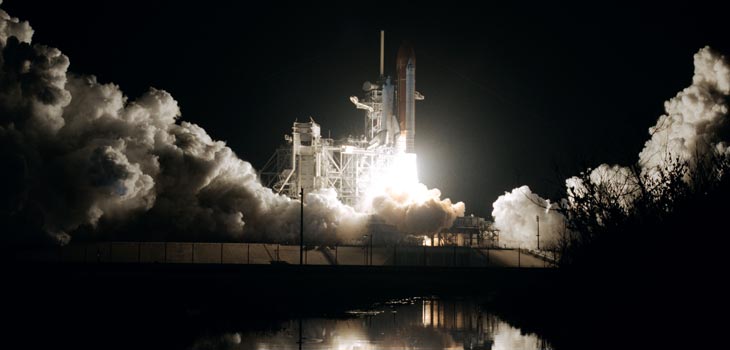
The space shuttle was supposed to answer all of America’s space launch needs, commercial, military, and NASA. Despite many accomplishments, the shuttle failed to lower the cost of space travel and, with two shuttle accidents, increase its safety and reliablity. Real solutions to the problem of cheap and reliable space travel, after a long time in coming, seem to be at hand.
The Prehistory of Winged Rockets
The first critical study of winged rockets came from Eugen Sanger, a specialist in aeronautics and propulsion who received a doctorate at the Technische Hochschule in Vienna and stayed on to pursue research on rocket engines. During World War II, Sanger showed how the addition of wings to a rocket could significantly extend its range. Initially, a winged rocket would fly to the modest scale, along with an arcing trajectory like that of an artillery shell. Upon reentering the atmosphere, however, the lift generated by the rocket’s wings would carry it upward, causing it to skip off the atmosphere like a flat stone skipping over water. Sanger calculated that with a launch speed considerably less than orbital velocity, such a craft could circle the globe and return to its launch site.
In a series of articles depicting the reusable rockets with wings on the future of space flight in Colliers Magazine in the early 1950s. The movie Conquest of Space further popularizes the concept in 1953, which depicted not only a winged, reusable rocket but a wheel-shaped space station and an expedition to Mars.
The X 15, which flew in the early 1960s, was an experimental winged rocket that tested many of the technologies and flying techniques that engineers would later use in the space shuttle. The X-15 repeatedly flew a trajectory that significantly resembled flight to orbit and returns. The X-15 ascended into space under rocket power flew in weightlessness and then re-entered the atmosphere at hypersonic speeds. With its nose high to reduce overheating and aerodynamic stress, the X-15 used thermal protection to guard the craft against the heat of reentry. After reentry, the X-15 then maintained a stable attitude throughout its deceleration, transitioned to gliding flight, and landed at a preselected location. The shuttle would do all these things, albeit at higher speeds.
The Air Force started the first winged severe reusable rocket project, known as Dyna Soar. Dyna Soar would have been lofted a single pilot on a Titan 3-C rocket for orbital flights. The project, however, was cancelled by then-Secretary of Defense Robert McNamara for lack of a clear, military mission.
The Evolution of the Space Shuttle Design
The vehicle we know as the space shuttle get first proposed in 1969 as part of a report by the Space Task Group, commissioned by President Nixon to map out a post Apollo space program. The report suggested a vigorous technology and exploration program that would have included a massive space station, serviced by a reusable space shuttle, lunar bases, and eventually expeditions to Mars. The report was greeted very coolly by the White House, the Congress, the media, and even the public at large. With President Kennedy’s goal of landing a man on the Moon and returning him safely to the Earth achieved, the appetite for large-scale, expensive space adventures had waned. More Earthbound concerns such as poverty, healthcare, and the environment seemed more critical than trips to Mars.
Even so, President Nixon was unwilling to end human spaceflight entirely. Aerospace was an essential component of the national economy. People employed in that industry constituted a critical voting block. Space travel was also a source of national pride. The Nixon Administration approved the space shuttle as NASA’s post Apollo project.
On its face, the rationale for building a reusable space shuttle seemed obvious. Hitherto, space travel had been conducted on expendable rockets with vehicles to be used only for one mission. It was as if people travelled on an aeroplane that was thrown away after every flight. If one could build a space vehicle that could be used many times, like an airliner, then the immense cost of space travel would decrease. Other space goals, such as space stations and expeditions to Mars, would be brought into the realm of the fiscally possible.
The X-15 program indeed showed that a winged vehicle with a rocket engine that could be reused many times as feasible. Other technologies necessary for building and operating a space shuttle, such as reusable thermo protection materials and digital checkout techniques, seemed within the grasp of engineers.
NASA proposed a two-stage space shuttle, consisting of a launcher and an orbiter, both winged, rocket-powered, and reusable. The vehicle would launch vertically, like a rocket, then after separating from the orbital stage, the launcher stage would land horizontally, like an aeroplane. The orbiter upon completing its mission in space, would reenter the Earth’s atmosphere and also land horizontally. The shuttle would take upwards to sixty-five thousand pounds to low Earth orbit. The cost of developing this system would be 12.8 billion dollars. NASA presented this proposal to the Nixon White House, buttressed by a study from the firm Mathematica Inc. that suggested that the fully reusable, two staged shuttle system would pay for itself at thirty-nine flights per year between 1978 and 1990. NASA indicated that the shuttle would fly more than fifty times a year, which would lower the cost per trip even more.
The White House Office of Management and Budget was sceptical of the claim. The OMB doubted that considering tighter budgets likely in the future and the changing design of satellites that would allow fewer of them to get launched, that the number of flights suggested in the Mathematica study was a realistic number. Also, the projected annual budget for NASA would not support a 12.8 billion dollar project, even if the almost inevitable cost overruns failed to materialize.
NASA and her contractor partners went back to the drawing board. They created a new proposal for a more modest shuttle system. NASA retains the original orbiter, but instead of a launcher stage, two strap-on rocket boosters and a large, they added external fuel tank. The cost of this system was projected to be 5.5 billion dollars.
This proposal was acceptable to the Nixon Administration, which approved it and requested funding from the Congress. After a heated political battle, they pass the funding for the space shuttle program in 1972. Rockwell International got the contract to build the orbiter. Morton Thiokol got the strap on rocket contract. Martin Marietta was developing the external fuel tank.
Thus NASA was charged with building a fleet of space vehicles that would launch every payload the United States needed launching, NASA, military, and commercial. It would do so at a significantly reduced cost and with greater safety and reliability. The fleet would comprise the national space line of the United States.
As it turned out, not even the agency that took men to the Moon and back in eight years could do all of those things successfully.
Building of the Space Shuttle
What one of the decisions space shuttle designers had to make was about the nature of the strap-on boosters. Should they be liquid-fueled or solid-fueled? Liquid fueled boosters would be more reliable, but solids cheaper. Engineers decided on cheaper and went with solid rocket boosters.
Another decision was over how would they protect the shuttle from the immense heat of reentry. Engineers decided on thermal protection tiles, to be glued on to the underside and leading edges of the vehicle.
Both decisions would come back to haunt NASA in the form of two destroyed orbiters, along with their crews of astronauts.
Rockwell began construction of the first shuttle orbiter in 1974. It was named the Enterprise, after the famous television starship. It was designed solely as an approach and landing test article. It completed a series of drop tests in 1977 from a modified Boeing 747.
The other orbiters get built
The Columbia, named after the sloop that accomplished the first American circumnavigation of the globe.
The Challenger, named after an American Naval research vessel that sailed the Atlantic and Pacific oceans during the 1870s.
The Discovery, named after one of two ships used by the British explorer James Cook in the 1770s during voyages in the South Pacific that led to the discovery of the Hawaiian Islands.
The Atlantis, named after the primary research vessel for the Woods Hole Oceanographic Institute in Massachusetts from 1930 to 1966.
The Space Shuttle Era Begins
The first test flight of the space shuttle Columbia took place in April 1981, crewed by veteran astronaut John Young and rookie Robert Crippen. Columbia made five more trips before being joined by space shuttle Challenger in April 1983. Discovery first flew in August 1984, followed by Atlantis in October 1985.
On the surface, the first four and a half years of the space shuttle era was one of great accomplishment. The shuttle launched some satellites and space probes, including the Long Duration Exposure Facility (LDEF), as well as some military and commercial satellites. Astronauts performed numerous scientific experiments, especially in the Space Lab Module, a kind of temporary space science station, carried in the shuttle’s cargo bay. The first tests of the Manned Maneuvering Unit, which permitted astronauts to EVA in space without the use of a tether, took place. Some satellites were captured and returned to Earth using the shuttle’s robotic arm. Some satellites, such as the Solar Max probe, were serviced in orbit and released.
The shuttle took some non-NASA astronauts into space, including commercial astronaut Charlie Walker. Two American politicians, Senator Jake Garn and Congressman (now Senator) Bill Nelson were on flights, in what must be the essential political junkets ever gone on.
In 1984, President Reagan announced that the space shuttle would have the central role in the construction of the first, permanently manned space station, later called Freedom. Optimism about the utility of the space shuttle system played a part in the prediction that the space station could be built for eight billion dollars in eight years, staffing eight people. That was not to be the case.
The shuttle did not, however, accomplish a decrease in the cost of space flight. The immense amount of time that it took to service a shuttle, to turn it around after a trip to get it ready for a new trip, limited the number of missions the shuttle fleet could perform per year. Technical glitches tended to delay shuttle flights further. There was no prospect of the shuttle ever getting anywhere near fifty trips a year. Even if it could, expendable launchers in other countries, such as the European Ariane, had started to eat into the commercial launch market, taking away potential payloads from the shuttle.
The Challenger Disaster
The pressure to increase the shuttle’s flight rate tended to make shuttle managers ignore or paper over technical problems with the space shuttle system. For instance, NASA and contractor engineers knew about the outgassing problem with the solid rocket boosters for months before the Challenger disaster. A seal on the SRB tended to become brittle in cold weather, causing superheated gasses to escape.
Nevertheless, on a cold, January day in 1986, the Challenger lifted off and 73 seconds into the flight was destroyed with her crew when the superheated gasses from the SRB ignited the hydrogen-filled external tank. The destruction of the Challenger and her team was especially traumatic due to the presence of a teacher in space Christa McAuliffe. McAuliffe was to be a first in a whole series of citizens in space. There would have been a journalist in space, an artist in space, and so on.
The Challenger Disaster caused a great deal of introspection at NASA. The space agency spent two and a half years recovering, redesigning the SRBs and taking other measures to improve the safety and reliability of the space shuttle fleet.
There were other effects of the disaster. They tacitly cancel the citizen in the space program, though Christa McAuliffe’s backup, Barbara Morgan, was eventually made an official NASA astronaut, though she has yet to get a flight assignment. President Reagan signed a directive removing military and commercial payloads from the shuttle manifest, an admission that the shuttle would never be the sole answer to access to space. A new space shuttle orbiter, the Endeavour, named after another of Captain Cook’s ships, was built and entered service in May 1992.
The Post Challenger Era
The next shuttle mission after Challenger was the flight of Discover, in September 1988. There followed a series of feats in space to rival those the shuttle fleet accomplished before the Challenger Disaster. One of the first things Endeavour did was to facilitate the capture of a communication satellite in the first three-person spacewalk. The Hubble Space Telescope was deployed and then serviced in subsequent missions. They execute more Spacelab and Spacehab science missions. Numerous satellites and space probes were deployed, including the Ulysses probe to study the sun, the Galileo Jupiter orbiter, and the Magellan Venus probe. The shuttle fleet supported the joint America/Russian missions to the Russian space station Mir. Shuttles helped to begin construction of the International Space Station.
The Search for New Solutions
Even so, with the realization that the space shuttle fleet would not be the answer to the problem of cheap access to space, other solutions were being sought. Both the Advanced Launch System (ALS) and the National Launch System (NLS) were projects attempting to find a way to replace expendable rockets with 1950s technology. They cancelled both when the development costs ballooned and when the prospect of deploying space-based weapons under the SDI program faded with the end of the Cold War.
The Evolved Expendable Launch Vehicle (EELV) program, started in the early 1990s, was more successful in that it led to the development of actual launch vehicles. These were the Boeing Delta IV and the Lockheed Martin Atlas V. These two families of launch vehicles are designed to address both military and commercial markets.
The search for a new way to launch people into space continued apace. Even before the Challenger Disaster, NASA and the Department of Defense began a joint project to build the National Aerospace Plane (NASP). This project would have developed a family of hypersonic vehicles that would provide high-speed global air transportation, a long-range air defence interceptor, and a low cost, single stage to orbit spacecraft. Once again the old story of cost overruns eventually doomed the project. Nevertheless, NASA continued to research hypersonic flight technologies.
The DC-X was a subscale prototype vehicle developed under the Strategic Defense Initiative for an advanced single stage to orbit vehicle to be called the Delta Clipper. The DC-X was a rocket that both launched and landed vertically. The DC-X flew in a series of successful flight tests in August and September of 1993, with the second series from June 1994-July 1995. An enhanced version of the DC-X, known as the DC-XA, was flight tested under the auspices of NASA from May 1996 to July 1996, when the vehicle gets destroyed when it tipped over upon landing.
The X-33 was a program started during the Clinton Administration to develop a single stage to orbit vehicle to replace the space shuttle. Though Boeing proposed a prototype based on the vertical take-off and landing concept pioneered by the DC-X/DC-XA program, NASA instead chooses a vertical takeoff, horizontal landing prototype offered by Lockheed Martin. This prototype, had it been successful, would have led to a full-scale single stage to orbit vehicle known as Venture Star. However, the attempt to develop too much-leading edge technology too soon led to cost overruns, schedule slippages, and eventual cancellation.
A kind of companion program to the X-33, the X-34, was designed to develop a low cost, air-launched vehicle, much like the successful Pegasus launcher. X-34 suffered much the same fate as the X-33.
Private Solutions
While various government-funded programs to replace the shuttle or to otherwise find a way to cheaply access space, private, entrepreneurial companies were attacking the problem. One of the first such attempts was the Otrag project, conducted in the mid-1970s by a German company and funded by Libya. The Otrag launch vehicle undertaken a series of flight tests from Zaire and then Libya. The pressure from the American, German, and Soviet governments ends the project as they see it as a means to build a military ballistic missile.
A company called Space Services Inc., based in Houston, Texas, was the next to try its hand at a privately developed, privately operated launch system. Their first attempt was a rocket called the Percheron, designed by longtime space entrepreneur Gary Hudson. The Percheron failed in a flight test in August 1981. Space Services was more successful in flight testing another vehicle, the Conestoga, made from old Minuteman rocket parts. This rocket was successfully flight tested in September 1982. Unfortunately, Space Services venture to become the first private space launch firm failed due to lack of investors and customers.
Throughout the 1980s and 1990s, a series of entrepreneurs tried and failed to develop low-cost launch systems privately. For a time it looked like that cellular satellite systems, which would have required the launch of constellations of hundreds of small satellites, might be the market that would get a private space launch industry started. Some of the more prominent companies were Pioneer Rocket Plane, Kistler Aerospace, Rotary Rockets, and Beal Aerospace. Rotary developed a prototype of their Rotan spacecraft, which lifted off like a rocket and landed like a helicopter, and flight tested it. Beal Aerospace static tested several rocket engines that would have powered their planned BA-2 launcher. These ventures tended to fail due to the collapse of the cellular satellite market, the lack of investors, and, in some cases, insurmountable technical challenges.
The X Prize
As an effort to jump-start private space flight, a group of space enthusiasts established the ten million dollar X Prize in the mid-1990s. The prize would go to the first group who, with private funding, would fly a piloted spacecraft capable of operating three people in a suborbital flight of a hundred kilometres and then do it again with the same shuttle within two weeks. Over two dozen teams eventually participated in the race for the X-Prize. The X-Prize was won in October 2004 by a team led by Burt Rutan of Scaled Composites Inc. with a vehicle called SpaceShipOne.
The X Prize seems to have succeeded in its goal of encouraging private space flights beyond the wildest dreams of its founders. SpaceShipOne had barely finished its final flight when aviation tycoon Richard Branson announced the start of a space tourism venture, known as Virgin Galactic, which will take paying passengers on suborbital rides into space in a vehicle to be designed and built by Burt Rutan. Indeed, space tourism may be the market that finally jump starts a private launch industry as other companies, including one started by Amazon.Com founder Jeff Bezos, are pursuing such ventures. And with the success of SpaceShipOne, investment capital seems to be more forthcoming.
Hotel magnate and space entrepreneur Robert Bigelow has already established a fifty million dollar Orbital Prize, to be given to the first private group to build and fly a spacecraft capable of going to low Earth orbit. Congress has passed legislation to encourage the growth of a space tourism industry.
Columbia and the Beginning of the End of the Shuttle
In February 2003, the space shuttle Columbia launched for her last mission. Unknown to anyone at the time, a piece of frozen insulation foam fell off of the external tank during launch and hit the leading edge of the left wing of the shuttle, stripping away some of its thermal tile protection. So, when the Columbia reentered the Earth’s atmosphere, the left wing, then the shuttle itself broke apart, killing her crew.
The second shuttle disaster caused as much NASA introspection about safety as had the first. As with Challenger, it looks like Columbia will result in a two and a half year recovery period.
The Future
More important, the Columbia Disaster has caused a complete rethinking of what the purpose of America’s civil space program should be. If people fly in space, some will eventually die as did the crews of Challenger and Columbia. So, should they not die for grander goals than just going around in circles in low Earth orbit?
With that question in mind, President George W. Bush announced a total reorientation of the American civil space program in January 2004. The space shuttle would complete the construction of the International Space Station and then would be retired in 2010. NASA would be charged with sending the first explorers beyond low Earth orbit for the first time in decades, back to the Moon, then on to Mars and beyond.
To accomplish this mission, NASA will build a new vehicle, the Crewed Exploration Vehicle. Various versions of it would service the International Space Station during the rest of its functional life, take astronauts back to the Moon, and then to Mars and beyond.
The shape of future space travel remains, of course, uncertain. But it seems likely that the private sector, starting with taking paying tourists into space, will finally fulfil the lost promise that the space shuttle failed to fulfil decades ago, by lowering the cost of space travel and increasing its safety and reliability. It is worth noting that Burt Rutan spent twenty million dollars doing pretty much what the X-15 project spent a billion and a half in current dollars doing.
How this nascent space launch industry will mesh with NASA exploration plans is uncertain. NASA seems more open to entrepreneurial space companies than it has ever been in its lifetime. Will these new private space vehicles be used to service and resupply the International Space Station as well as future NASA moon and interplanetary ships? Only the future will tell.