
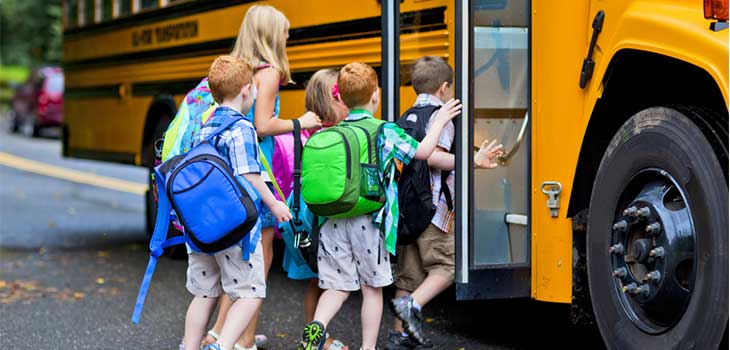
I will present the arguments against mandating seat belts in American school buses, while addressing the concerns of parents and others, based on my research. The points I address are: lap belts (as opposed to shoulder belts and the costs of installing them) proven unsafe for small children; “compartmentalization”–the egg crate effect and its proven safety; size and structure of buses; and, cost effectiveness as compared with the very low fatality rates. My intention is to educate parents and other concerned citizens on the reasons the NHTSA has not made seat belts in school buses mandatory.
In December 1996, President Bill Clinton asked Americans to remember to wear their seat belts as the first line of defence against injury and death. In April 1997, U.S. Transportation Secretary Rodney Slater proposed a Presidential Initiative to Increase Seat Belt Use. Passenger cars have been required to have seat belts since 1968. Furthermore, the cost of fines for failing to wear a seat belt increases every year. It’s obvious that United States government officials feel passionate about seat belt usage. So, why aren’t school buses required to have them?
No federal law that exists mandating that regular school buses should install seat belts. State and local authorities are allowed to install them if they wish, but with an estimated cost of around $1500 per bus to install seat belts, why would they? The law says it’s okay not to have them, so why fix what’s not broke?
Parents and other citizens are concerned. The National Parent Teacher Association has asked that every new school bus should install seat belts. Parents are not unreasonably worried. Every year automobile accidents take over 41,000 lives. It is not irrational to assume that children would be better protected if buckled up on their way to school and home.
Seat belt advocates list several significant reasons for requiring seat belts in school buses:
- Reduce the number of injuries and fatalities in collisions
- Reduce the number of non-collision injuries children sustain from sticking their arms and heads out of windows and falling out of their seats
- Improve behaviour of children on buses by keeping children seated
- Reinforce the message to “Buckle Up.”
The National Highway Traffic Safety Administration (NHTSA) requires all new school buses to meet safety requirements above those of passenger cars. These include improved emergency exits, seating, fuel systems, and joint stability. The administration is responsible for establishing federal safety standards for all motor vehicles and works with states on school bus safety programs. Nevertheless, the NHTSA does not currently require school buses to install seat belts.
The National Transportation Safety Board (NTSB) has concluded that seat belts would provide little, if any, added protection for children involved a school bus accident. In 1987, the NTSB concluded in a study that most fatal injuries caused by school bus collisions were due to seating positions in direct line of impact, and that seat belts would not have prevented most of these tragedies.
Because there is no compelling evidence that seat belts would provide added safety for school bus occupants, and because of the outstanding safety record of school buses, the NHTSA has concluded that there is insufficient evidence for requiring safety belts to be installed. Several additional factors determine the stance against mandating seat belts on school buses.
Compartmentalization: The Egg Crate Effect
The NHTSA relies on a concept called “compartmentalization” to ensure the safety of school bus riders. Closely spaced, high-backed seats with impact absorbing materials on the fronts and backs prevent children from being thrown far and hard in the event of a collision. Compartmentalization gives an egg crate-like protection by providing confined spaces that are constructed to cushion the blow in an accident.
Critics agree that compartmentalization does nothing for side-impact crashes, and seat belt advocates are putting the pressure on authorities to examine their current policies.
Size and Structure of School Buses
Federal regulations require installation of restraints in vehicles based on their size and weight. Smaller school buses, those weighing less than 10,000 pounds, are expected to have seat belt restraints. The NHTSA has ruled that small buses fall into the same category as passenger cars and trucks that are mandated to have safety belts. Regular school buses are more massive and provide better crash impact than passenger vehicles, thus eliminating the requirement of seat belt protection.
Lap Belts vs Shoulder Harnesses
Studies show that lap belts have the potential to cause abdominal and head injury in children who are slammed forward in a crash. Three-point shoulder harnesses would be ideal for restraining children but are impractical as there is currently no realistic way to install them on school buses. Thye could implement the Window seats with shoulder harnesses, but aisle seats provide no place to anchor the straps.
Cost Effectiveness
An average, in school bus accidents ten children die per year. Compare this to the over 23 million children who travel to and from school and school-related activities, and you have a tiny percentage of school bus fatalities. In 1989, the National Academy of Science concluded that the overall benefits of installing seat belts, with an estimated cost of about $470 million to install them in the approximately 384,000 school buses in America, would be insufficient for mandating belt restraints. The NAS also stated that funds of this magnitude we would better spend on safety programs that would be beneficial in preventing injuries and fatalities. For example, consider that almost three times as many children die entering and exiting school buses, at bus stops, and walking to school.
Practicalities
Certain questions arise when visualising the possibility of seat belts in school buses: How much time will be consumed while bus drivers make sure all children are buckled before moving? Will unruly children use the seat belts as weapons? If a bus were to be involved in a wreck, who would be responsible for making sure all passengers were unbuckled? What if the driver were hurt and unable to assist children in vacating the bus? Would an additional employee be needed, and what would the cost factor be for hiring another employee for each bus?
All of these questions need we should consider in determining whether installation of seat belts on school buses is practical.