
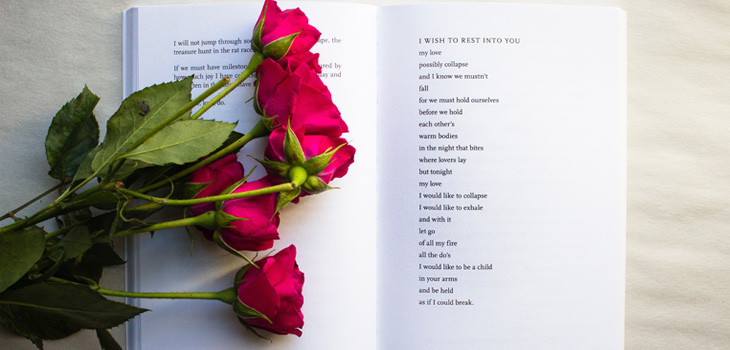
The following article explains the fundamentals of poetry.
Poetry can at times be unapproachable, and college English students often dread the poetry unit of their English Composition classes. This article explains some of the fundamental principles of poetry.
Imagery
Edgar Allen Poe called poetry, “The rhythmical creation of beauty.” Emily Dickinson said, “If I read a book and it makes my whole body so cold that no fire can ever warm me, then I know that it is poetry.”
Poetry takes the raw material of words and creates something much higher than what is present.
Poets rely heavily on imagery, which is typically done by jumping from the literal to the abstract. For example, a pebble on a beach is not merely a pebble on a beach, but instead an image of life’s meaninglessness. Flea is not a biting insect, but instead an image of death.
Poets use a variety of language techniques to create these images.
Metaphor – A metaphor is an implied equation between two things. For example, “spring is a box of sweets.”
Simile – A simile is a specific comparison between two things using the words “like” or “as.” For example, “The virtuous soul is like a box of timber.”
Metonymy- Metonymy is the substitution of a word for another with which you associate it. For example, in the phrase, “the whole world turns to coal,” coal is standing in for destruction.
Personification – Personification is ascribing human characteristics to non-human entities. For example, “the dew wept.”
Tone
The tone is the essence of what you did write and is used to convey or provoke anger, hurt, joy, apprehension, etc., depending on the poet’s goal. Importantly, the tone should create a mood without telling the reader what to feel. Poets wanting to build a sound should show rather than tell.
For example, in the phrase, “some things are more important beyond this fiddle,” the author has shown that the speaker does not like something without simply writing, “I don’t like the fiddle.”
Irony
The irony is a standard way of achieving the tone, and you do it when two ideas or images are put together that would seem more naturally separate. For instance, in the phrase, “Moving from Cheer to Joy, from Joy to All, I take a box.”
Usually, the irony is created in that phrase by placing words used to describe emotion alongside the word “box.” The poet is writing about an experience in a grocery store, and the words are not in fact words for feeling but, in fact, brands of laundry detergent.
A further irony you create by the knowledge that the poet is a man writing in the 1950s, and would, therefore, seem out of place in a grocery store.
Rhythm
Rhythm is a classic component of poetry, and there are specific rules.
Poetry scholars who analyze rhythm divide the lines of a poem into sections called feet and classify them in the following manner:
Monometer: one foot
Dimeter: two feet
Trimeter: three feet
Tetrameter: four feet
Pentameter: five feet
Hexameter: six feet
Heptameter: seven feet
Octameter: eight feet
Once the number of feet is determined, a poetry scholar then observes the syllabic structure within each foot and classifies them in the following manner:
Iambic: a short-stressed syllable followed by a long-stressed syllable. For example, words like “indeed,” “about,” or “against.”
Trocheeic: a long-stressed syllable followed by a short-stressed syllable. For example, words like “certain,” “women,” or “patient.”
Dactylic: a long-stressed syllable followed by two short-stressed syllables. For example, “muttering,” “restaurants,” or “oyster-shells.”
Anapestic: Two short-stressed syllables followed by a long-stressed syllable. For example, “afternoon,” “do I dare,” or “overwhelm.”
Spondeeic: A long-stressed syllable followed by another long-stressed syllable. For example, “one night,” or “shirt sleeves.”
So, for instance, in the phrase, “Let us go then you and I,” the rhythm scheme would be trocheeic tetrameter.
Rhyme
Placing two like-sounding words together, typically at the end of a line, creates a rhyme. When poetry scholars talk about rhyme, they are generally referring to a rhyme scheme and map it out with letters. For example, if a poem is four lines long and every other line rhymes, then the rhyme scheme would be “abab.”
Rhyming is typically used to show when lines break, but it can also be used to show how words fit together. Most of the time, words that rhyme will somehow be connected.
Some poets, mainly free verse poets, like to use off rhyme where the words sound similar but not exactly alike. For example, cow and plow would be examples of explicit rhymes, but blood and cold would be off rhyme.
There are two types of explicit rhyming:
Assonance: when the vowel sounds to match. For example, trim, dim or him.
Alliteration: when the consonant sounds to match. For example, fresh, fire coal, falls.
Poem Construction
You typically write poems in lines, and these lines are placed together in various ways to form the body of the poetry.
If you only put two lines together, you write the poem in couplets.
If you put three or more lines together, you write the poem in stanzas, which you can colloquially refer to as poem paragraphs.
When a series of stanzas are made up of regular lines, for example six four-line stanzas, the stanzas are said to be isometric. If the stanzas are made up of random lines, for instance, three four-line stanzas followed by one three-line stanza, the stanzas are said to be heteromeric.
Common Types of Poetry
Poems come in all forms, but here are a few common types.
The Villanelle. The villanelle is an intricate braiding of 19 lines, many of them repeated, that is divided into about five stanzas.
The Pantoum. The pantoum can be of any length, but you must divide it into four-line stanzas, also called quatrains. The first and last lines of each stanza are always the same, and the rhyme scheme is abba.
The Sonnet. Sonnets are always 14 lines long, and the rhythm scheme is typically iambic pentameter. Shakespearean sonnets have a rhyme scheme of abab cdcd efef gg. Petrarchan sonnets have a rhyme scheme of abba abba cde cde.